
Many consumers view choosing an electricity retailer as a commodity switching exercise -compare rates on a price comparison website, check reviews, select the cheapest option, and repeat every two years. This approach misses the strategic dimension.
Choosing an electricity retailer in Singapore’s Open Electricity Market is a risk transfer mechanism. When you sign a fixed price plan, you are purchasing price certainty – a hedge against energy inflation. When you sign a Discount Off the Regulated Tariff plan, you are taking a short-term tactical bet that energy prices will soften or remain stable.
🎥 Prefer watching? Check out the video version of this post.
The question is not whether to participate in the Open Electricity Market. It is how to structure your contract to align with your macro outlook and preferred payment method. This article explains the mechanism, provides benchmarks, and identifies the structural factors that determine total savings.
Table of Contents:
- Is the Open Electricity Market Right for You?
- How the Electricity Tariff Works
- The Electricity Tariff Trend (Benchmarking)
- Standard Fixed Price Plans
- Standard Discount Off the Regulated Tariff Plans
- Non-Standard Price Plans
- Wholesale Electricity Plans
- The Tie Breaker Rule
- Conclusion
- Trivia
Disclosure: This post contains a referral code. I may receive a commission when you use my referral code to sign up. There is no additional cost to you. You will receive a $20 referral bonus. I only recommend products or services that meet my needs and expectations.
One Minute Summary:
- SP Group’s regulated tariff recalculates quarterly based on the previous quarter’s fuel costs. When global energy prices spike, you have approximately 3 months to lock in a fixed price plan before the tariff catches up.
- To decide between a fixed price plan and a discount off the regulated tariff plan, you need to assess whether you expect energy prices to rise or fall during your contract term.
- Unless you can control your usage precisely, a usage-based or timing-based plan will likely generate more cognitive workload than cost savings.
- When evaluating an electricity retailer, check reviews, customer support, and operational track record. Retailers with multi-year presence in the market tend to have more stable service infrastructure.
- Consider credit card cashback to boost your total savings further.
Part 1: Is the Open Electricity Market Right for You?
Before diving into plan structures, assess whether switching from SP Group’s regulated tariff makes sense for your household.
You may benefit from switching to open electricity market if you:
- Have high energy consumption (more than 200 kWh/month) where annual savings exceed $100
- Have a macro view on energy prices and can select the appropriate plan structure (Fixed vs. Discount Off Tariff)
- Can align your retailer choice with a credit card that offers recurring bill rebates
You may prefer staying with SP Group if you:
- Have low energy consumption (less than 120 kWh/month) where savings are under $5 each month
- Do not want to monitor contract expiry dates or deal with auto-renewal clauses
- Prefer the simplicity of the regulated tariff without contractual obligations
If you fall into the first category, the remainder of this guide will help you structure your decision.
Part 2: How the Electricity Tariff Works
Part 2.1: The Lag Effect
SP Group, Singapore’s default electricity supplier, calculates the regulated tariff quarterly based on the average cost of fuel oil and natural gas from the previous quarter. Under the framework established by the Energy Market Authority (EMA), this tariff adjustment methodology is transparent and published quarterly.
This methodology creates a structural delay. SP Group procures fuel contracts in advance and locks in costs for the quarter. When global spot prices for LNG or fuel oil spike mid-quarter, SP Group continues to supply electricity at the previous quarter’s fuel cost until the next tariff revision. This is why the regulated tariff lags behind real-time market movements by approximately 90 days.
Consider the Russia-Ukraine conflict in February 2022 – a massive macro energy shock. In that quarter, the regulated tariff remained artificially low for approximately 90 days while SP Group operated on the previous quarter’s fuel costs. The tariff then adjusted upward in the following quarters: 9.83% in April and 7.98% in July.
This is not a glitch. This is the calculation method.
Part 2.2: The Opportunity (Bullish Energy Scenario)
When global energy prices spike (e.g., geopolitical shocks, OPEC production cuts, LNG supply constraints), the regulated tariff remains artificially low for approximately three months. During this period, the tariff has not yet caught up with current market prices.
This is your strategic entry point to lock in a fixed price plan. You are locking in a rate before the inevitable tariff adjustments.
Part 2.3: The Risk (Bearish Energy Scenario)
Conversely, when global energy prices collapse (e.g., LNG oversupply, renewable energy displacement), the regulated tariff remains elevated. The tariff is still pricing in the previous quarter’s higher fuel costs.
This is when discount off the regulated tariff plans yield maximum value. You are capturing the spread between the inflated regulated rate and current market reality.
Part 2.4: Summary
The regulated tariff is not an efficient market in practice. It is a smoothed, backward-looking calculation. As a consumer, your task is to determine whether you believe energy prices will rise or fall over your contract term, then select the plan structure accordingly.
Part 3: The Electricity Tariff Trend (Benchmarking)
Part 3.1: Understanding the Historical Range
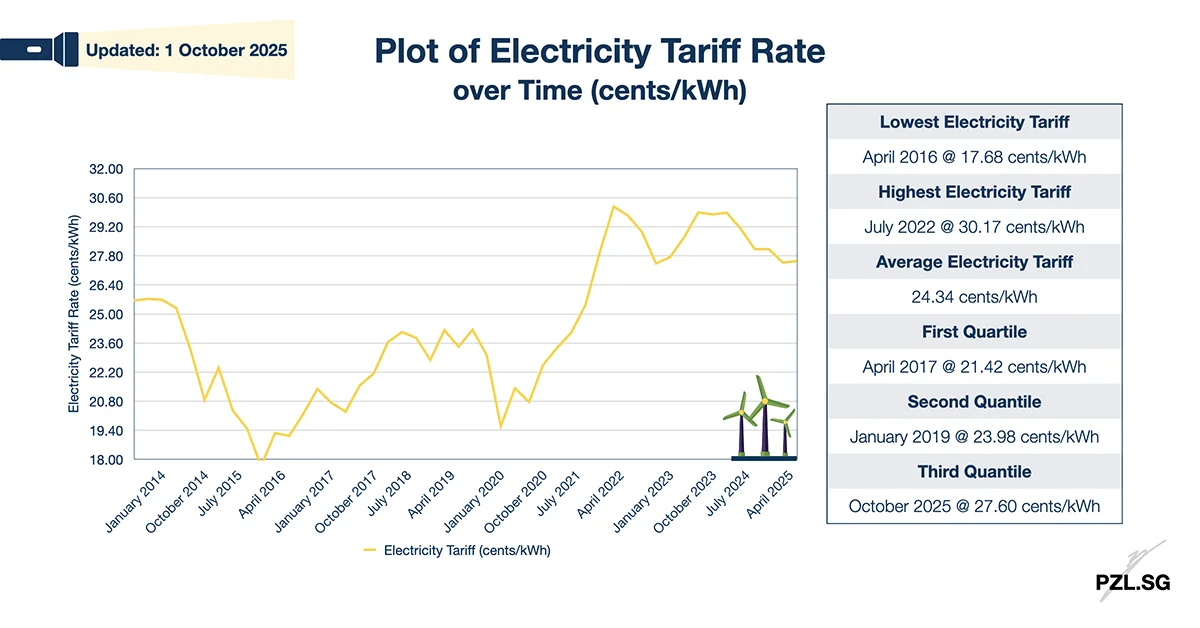
The following chart plots the regulated tariff from 2014 to present. These figures represent historical averages and thresholds based on data collected over the past decade.
Key Observations:
- Lowest tariff: 17.68 cents/kWh
- Relatively cheap threshold: Below 21.42 cents/kWh
- Average tariff: 24.34 cents/kWh
- Expensive threshold: 27.60 cents/kWh
Part 3.2: Deriving Benchmarks for Retailer Evaluation
These thresholds are your reference points. For example, if a retailer offers 26 cents/kWh for a fixed price plan, we now know this is above the historical average but below the “expensive” threshold. The question is: do you expect the tariff to rise further, or fall back?
Based on this historical range, we can establish benchmarks for evaluating retailer offers:
For fixed price plans:
- Optimal rate: Less than 21.43 cents/kWh (before GST)
- Maximum tolerance: 27.55 cents/kWh (before GST)
For discount off the regulated tariff plans,
- Optimal discount: Approximately 15% to 20%
- Minimum acceptable discount: Approximately 10% to 12%
These figures assume the electricity tariff continues to fluctuate within the current range. If the tariff breaks out of this band (e.g., due to structural shifts in global energy markets), you may pay more (or less) than the regulated tariff.
Now that you have the benchmarks, the next step is to match them to your macro outlook. If you expect energy prices to rise, you may want to lock in a rate below the historical average before the tariff adjusts upward. This is where fixed price plans fit in. Conversely, if you expect prices to stabilise or fall, discount off the regulated tariff plans allow you to ride the downward adjustment. Let’s examine each structure further.
Part 4: Standard Fixed Price Plans
A fixed price plan locks your electricity rate over the contractual period, irrespective of regulated tariff movements.
Part 4.1: When to Consider a Fixed Price Plan
You may consider a fixed price plan if you
- Expect energy prices to rise due to supply constraints, geopolitical risk, or monetary policy shifts
- Value budget predictability and are willing to forgo potential savings if energy prices fall
- Have high baseline consumption (e.g., more than 450 kWh/month) where rate volatility materially impacts household cash flow
| Contract Length | Lowest Fixed Price | Retailer |
|---|---|---|
| 6 months | 24.88 cents/kWh | Geneco |
| 12 months | 28.67 cents/kWh | Geneco, Keppel Electric, Pacific Light, Senoko Energy, Tuas Power |
| 24 months | 25.88 cents/kWh | Geneco |
Part 4.2: 6-Month Contract
The average rate for 6-months contracts 25.94 cents/kWh. The cheapest option is:
- Geneco’s Give Us a Try at 24.88 cents/kWh
This represents a 10.63% discount to the prevailing regulated tariff. If this does not meet your threshold, consider a longer lock-in period.
Part 4.3: 12-Month Contract
The average rate for 12-month contracts is 28.89 cents/kWh. The cheapest options are:
- Geneco’s Get it Fixed 12
- Keppel Electric’s Fixed 12
- Pacific Light’s Savvy Saver 12
- Senoko Energy’s LifePower12
- Tuas Power’s PowerFix 12
All offer 28.67 cents/kWh. This is a worthy consideration if you are comfortable locking in rates for 12 months.
If you sign up with Senoko Energy, use referral code LFSBFXNC for a $20 bill rebate. This code is stackable with existing promotions.
Part 4.4: 24-Month Contract
The average rate for 24-month contracts is 27.44 cents/kWh. The cheapest option is:
- Geneco’s Get it Fixed 24 at 25.88 cents/kWh
Part 5: Standard Discount off the Regulated Tariff Plans
A Discount Off the Regulated Tariff (DOTT) Plan applies a percentage discount to the prevailing SP Group regulated tariff each month.
Part 5.1: When to Consider a Discount off the Regulated Tariff Plan
You may consider a discount off the regulated tariff plan if you
- Expect energy prices to fall or stabilise
- Are comfortable with monthly bill variability
- Have low baseline consumption (e.g., less than 200 kWh/month) where absolute variance in monthly bills is less than $10
- Are prepared to remain exposed to upstream energy volatility
Part 5.2: Cheapest Discount off the Regulated Tariff Plans
| Contract Length | Highest Discount | Retailer |
|---|---|---|
| 12 months | 10% | Tuas Power |
| 24 months | 1.635 cents/kWh (~5.4%) | Senoko Energy |
Plan 6: Non-Standard Price Plans
Some electricity retailers offer non-standard price plans such as usage-based or time-of-use structures. These plans introduce execution complexity without proportional financial benefit for most households.
To explain, time-of-use plans require you to shift laundry, cooking, and air-conditioning usage to off-peak hours (typically 10 PM to 7 AM). This is probably feasible for industrial users with programmable equipment. For residential users, it requires consistent behavioural adjustments. You must track consumption patterns monthly to verify savings.
For many households, the time cost of monitoring peak/off-peak usage likely outweighs the savings. However, if your routine naturally aligns with off-peak hours, these plans can work in your favour.
Part 6.1: When to Consider Non-Standard Plans
You may consider non-standard price plans if you:
- Operate home-based servers, workshops, or EV charging infrastructure where load-shifting is already automated
- Have a domestic helper or family structure that can accommodate off-peak routines without friction
Part 6.2: Non-Standard Fixed Price Plan
PacificLight’s Easy Peasy plan offers 25.50 cents/kWh with no contract. However, it includes a daily charge of $0.55 – an additional cost of approximately $16.73/month.
Part 6.3: Non-Standard Discount off the Regulated Tariff Plan
Keppel Electric offers a 15% discount off the regulated tariff with its SureSave Dot plan. It has been a while since a two-digit discount was available. This plan is worth evaluating.
Part 6.4: Non-Standard Usage-Based Plan
PacificLight’s Stack It Up 24 charges:
- 28.82 cents/kWh for the first 300 kWh
- 26.54 cents/kWh for 301 – 600 kWh
- 25.74 cents/kWh for consumption above 600 kWh
Part 6.5: Non-Standard Timing-Based Plan
If your electricity usage is consistent throughout the day and night, consider:
- Geneco’s Get It 7 to 7;
- Keppel Electric’s Weekend Saver Plan;
- Pacific Light’s Save While Sleeping 24;
- Pacific Light’s 9 to 9;
- Senoko Energy’s LifeSavvy24;
Depending on the retailer’s offer, the range is between 16.08 cents/kWh (off-peak) and 32.9 cents/kWh (peak). Most plans require a 24-month contract.
Part 7: Wholesale Electricity Plans
Wholesale electricity plans in Singapore peg your rate to the real-time Half-Hourly Energy Price published by the Energy Market Company.
Such plans expose you to intraday volatility. During heatwaves, grid stress, or fuel supply disruptions, wholesale electricity prices can spike 10 to 20 times above average. For example, during the grid stress event on 17 July 2022, wholesale prices spiked to 450 cents/kWh, compared to the 2022 average of approximately 30 cents/kWh – a 15-fold increase in a single period This single day of extreme pricing can erase months of savings.
Part 7.1: When to Consider Wholesale Electricity
You may consider wholesale electricity if you
- Have real-time monitoring systems and can curtail non-essential load during price spikes
- Operate commercial or industrial facilities with demand-response capabilities
For residential users, this is a speculative position with material downside risk. You should probably avoid unless you have automated systems to shift consumption in response to price signals.
Part 8: The Tie Breaker Rule
While rate selection is primary, the payment method is the tie breaker. A credit card offering 3% to 4% rebate on recurring utility bills yields $10 to $12 on a $300 monthly electricity bill.
Part 8.1: The Strategy
- Shortlist the top 2 to 3 retailers with the most competitive pricing structure.
- Check that the retailer allows you to pay via credit card
- Select a credit card that offers credit card rewards for utility payments, e.g., OCBC 365 offers 3% cashback on recurring electricity bills
This way, you further reduce your bill and can potentially beat the retailer with the lowest electricity rate.
Part 8.2: Why Payment Method Matters
Assume that Retailer A offers 28.5 cents/kWh and accepts only GIRO (no rebate). Retailer B offers 28.8 cents/kWh but accepts credit cards with 3% cashback. On a 300 kWH monthly bill,
- Retailer A: 300 kWh x $0.285 = $85.50 (no rebate)
- Retailer B: 300 kWh x $0.288 – (300 kWh x $0.288 x 3% cashback) = $83.81
Retailer B, despite a higher rate, yields a lower final cost.
Part 9: Conclusion
Electricity is an essential need in most households. In addition to reducing the use of electrical appliances and practicing good energy hygiene habits, you can potentially save by buying electricity from a licensed electricity retailer in the Open Electricity Market.
Before doing so, be aware that the Open Electricity Market is not just about finding the cheapest retailer. Treat it as a payment optimisation exercise and find a price plan that aligns with both your energy outlook and the payment method that maximises credit card rewards. This way, you will extract more value than chasing the absolute lowest rate on a price comparison website.
The best electricity price plan in Singapore is not the one with the lowest rate. It is the one that aligns with your energy outlook, consumption profile, and payment method. If you decide to switch to a new retailer, ensure you review the contract’s early termination charges and auto-renewal clauses
In the long run, the strategic goal is to minimise cognitive overhead while maximising total economic benefit.
Part 10: Trivia
As of this writing, there are ten participating electricity retailers on the Open Electricity Market website. However, I could not find any current offers from Diamond Electric Pte Ltd, Flo Energy Singapore Pte Ltd, Sunseap Energy Pte Ltd, and Union Power Pte Ltd. Additionally, Sembcorp Power has not updated its price plans since 20 January 2024. I could not locate the factsheet on its website.
First Published: 27 February 2019
Last Updated: 4 February 2026


Leave a Reply