
Back in November 2018, the Energy Market Authority (EMA) launched the Open Electricity Market. Since then, you can choose which company you prefer to work with for your electricity supply. Before you make that decision, let’s understand the open electricity market first.
Table of Contents:
- About the Open Electricity Market
- Wholesale Electricity Market
- Standard Fixed Price Plan
- Standard Discount off the Regulated Tariff Plan
- Non-Standard Price Plan
- My Evaluation of the Open Electricity Market Retailers
One Minute Summary:
- Regardless of whether you make a switch or not, you will enjoy the same reliable and efficient electricity supply.
- At this time, there are three options available, 1) Remain with SP Group; 2) Purchase Wholesale Electricity; or 3) Switch to a plan that an electricity retailer offers.
- Standard Fixed Price Plan: You pay the same electricity rate throughout the contract period.
- Standard Discount off the Regulated Tariff Plan: You enjoy the same discount rate throughout the contract period.
- Non-Standard Price Plan: The electricity retailers’ creativity rules the plan.
Part 1: About the Open Electricity Market
Part 1.1: Same Electricity Supply
According to a statement from SP Group, “SP Group will continue to operate the national electricity grid. Hence you will enjoy the same reliable and efficient electricity supply. This is regardless of whether we make a switch (to an open electricity retailer)”.
In other words, your electricity supply will remain the same even if you switch to another electricity retailer.
Part 1.2: Electricity Tariff
According to another statement from SP Group, “Energy Market Authority (EMA) regulates the electricity tariff. To reflect the actual cost of electricity, EMA will make quarterly adjustments to the electricity tariff”.
To put it another way, your monthly bill reflects the average cost of electricity. In truth, this is not an accurate reflection of its actual cost. Consequently, the Energy Market Authority will make quarterly adjustments (up or down) to reflect the real cost of electricity. The following infographic summarises the past electricity tariff trend.

Part 2: Wholesale Electricity Market
Besides the (default) regulated tariff from SP Group, you can choose to buy electricity from the wholesale electricity market.
Part 2.1: How does the Wholesale Electricity Market work?
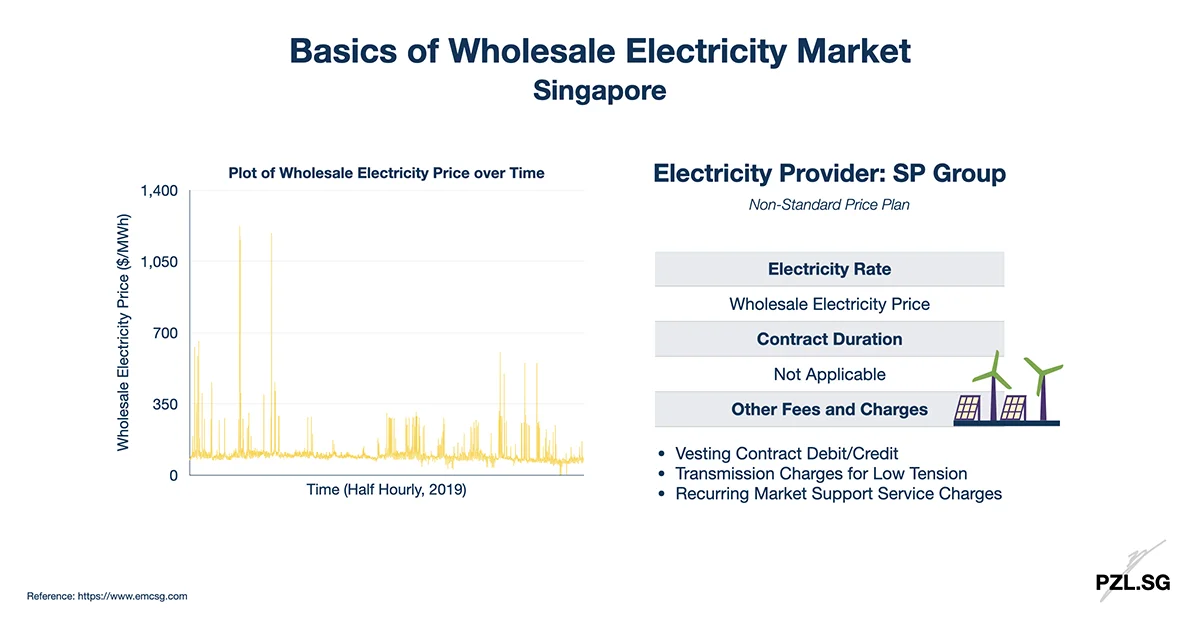
In reality, the wholesale electricity price fluctuates according to the market’s demand and supply. In this situation, you can choose to buy it at the wholesale electricity rate (updated every half an hour).
Part 2.2: Advantages of Wholesale Electricity Market
Overall, you get to buy electricity at the wholesale rate. In detail, this is the same rate that the open electricity market retailer buys electricity for. Therefore, there is a chance that you will end up with the cheapest electricity rate for that period.
Part 2.3: Disadvantages of Wholesale Electricity Market
Without a proper hedging strategy, you may end up paying a higher price to this end. This is especially because of the high frequency of fluctuation (every half an hour).
Part 3: Standard Fixed Price Plan
Altogether, there are two types of standard price plans:
- Fixed Price Plan; and
- Discount Off the Regulated Tariff Plan.
In this section, we will discuss the standard fixed price plan.
Part 3.1: How does the Standard Fixed Price Plan work?
Firstly, the electricity retailer will charge a fixed electricity rate. Under those circumstances, you will pay the same rate throughout the contract duration.
Part 3.2: Advantages of Standard Fixed Price Plan
On the positive side, you may disregard the quarterly fluctuation in the electricity tariff. This is because you will be paying the same fixed rate anyway. Consequently, this fluctuation has no impact on your monthly electricity bill. So long as the electricity tariff stays above the fixed price, you will continue to save on your electricity bill.
Part 3.3: Disadvantages of Standard Fixed Price Plan
On the contrary, you will pay a higher electricity bill if the electricity tariff falls below the fixed rate. In the long run, you will be worse off by making the switch!

Part 4: Discount Off the Regulated Tariff Plan
Next, we move on to understand the discount off the regulated tariff plan.
Part 4.1: How does the Discount off the Regulated Tariff Plan work?
In essence, the electricity retailer will offer a fixed discount off the prevailing electricity tariff. As a result, you will pay the discounted rate throughout the contract duration.
Part 4.2: Advantages for Discount off the Regulated Tariff Plan
On the positive side, you will enjoy the same rate of discount regardless of the quarterly fluctuation in the electricity tariff. In the long run, you will be better off. If the electricity tariff continues to be low, then you will enjoy greater savings on your electricity bill.
Part 4.2: Disadvantages of Discount off the Regulated Tariff Plan
On the contrary, this discount has a direct correlation to the prevailing electricity tariff. Consequently, you will pay a higher price when the electricity tariff rises. Despite that discount, you will be paying a higher electricity bill to that end.

Part 5: Non-Standard Price Plan
Part 5.1: How does the Non-Standard Price Plan work?
Generally, these plans do not follow the usual way of charging their customers. Instead, the formula depends on how creative the electricity retailers are. (Well, maybe that’s why they are termed “non-standard”.)
For instance, a retailer may charge a rate for electricity based on the period of usage. For instance, the rate will be 20 cents/kWh from 7 am to 7 pm, and 15 cents/kWh on other timing. Moreover, some plans have fancy initial contract terms and terrible terms on renewal.
Part 5.2: Advantages of Non-Standard Price Plan
You may enjoy some savings if you are certain of its terms and conditions. Generally, you will need to know your household’s electricity consumption to maximise the savings.
Part 5.3: Disadvantages of Non-Standard Price Plan
Some plans require you to install a Smart Meter (“AMI”) and this costs an additional $42.80. Besides, are you sure that you can control your electricity consumption that well?
Part 6: My Evaluation of the Open Electricity Market Retailers
All things considered, the non-standard plans tend to have more complex terms of offer. Given the simplicity of the standard price plans, I prefer to make my life simple. In short, choose a
- Discount off the regulated tariff plan if the electricity tariff continues to fall; and
- Fixed price plan if the electricity tariff continues to rise.
To make the right choice, check out my detailed comparison on How to Choose an Open Electricity Market Retailer.
Checklist:
- How much electricity do you consume on average?
- Calculate your potential savings from each type of plan.
- Read the terms and conditions carefully before making a switch.
First Published: 23 January 2019
Last Updated: 1 December 2022


Leave a Reply