
Altogether, we will apply the administrative process when you die without a will in Singapore. In this situation, we say that you have died intestate. Accordingly, we will administer and distribute your estate in accordance with the Intestate Succession Act (Cap. 146) (for non-Muslim estates) or in accordance with Muslim law (for Muslim estates).
Before that, we need to answer four questions first:
- What is the Deceased’s domicile?
- What are the Deceased’s estate?
- Who should distribute the Deceased’s estate?
- Who are the beneficiaries? And how much is their entitled share?
- Should You rely on the Administrative Process?
One Minute Summary:
- Dying without a will means that you have no say over what’s going to happen to your estate.
- We may distribute some assets without the Letters of Administration, e.g. an insurance policy with nomination.
- Otherwise, your next-of-kin may apply to become the administrator for your estate.
- After completing the administrative process, your administrator will distribute your estate according to the Intestate Succession Act.
- In sum, this process takes at least two to three months, depending on its complexity.
Part 1: What is the Deceased’s domicile?
In essence, your domicile is the place where you intend to make it your permanent home. This is for the purpose of carrying out the primary probate process. Furthermore, it will also decide who will become the personal representative to carry out the administrative process for the estate. In general, there are five factors to determine a person’s domicile:
- Nationality;
- Place of Residence;
- Whether he bought any property in the country;
- Whether his family is with him;
- Length of time that he has been living in the country.
Part 2: What are the Deceased’s estate?
When you die without a will, there is a high possibility that you didn’t get a chance to organise your assets and liabilities. As a result, we need to spend some time to gather and find out the estate that you have left behind. In the same way, we will consolidate this information together with their respective value. In short, these information will form the “Schedule of Assets”.
Thereafter, we will check with the relevant institutions on whether a grant is required in order to realise the assets. This is because we may be able to transfer and distribute some assets without a grant.
Example: CPF monies, flats held under joint tenancies, certain insurance policies with nomination.
If a grant is not necessary, then we may proceed to distribute the assets directly. In other words, we do not need to spend time going through the administrative process.
In the event that we cannot distribute the assets to your beneficiaries directly, there are two options:
Option 2.1: Value of Estate is less than S$50,000
In this situation, your next of kin may consider to apply to the Public Trustee to administer the estate. If the Public Trustee agrees to administer the estate, then we do not need to apply for a grant.
Note: The Public Trustee charges a fee for the administration of estate.
Option 2.2: Value of Estate is more than S$50,000, or Public Trustee does not agree to administer the Estate
In this case, we may proceed to apply for Letters of Administration. To be sure, we need to submit the application within six months from your death. Emphatically, we may submit an application in person, through a solicitor, or via legal aid.
Approximate cost: $1,000.00 (if you submit an application personally)
Part 3: Who should distribute the Deceased’s estate?
For Option 2.2, we need your next of kin to apply to the Court for a grant for Letters of Administration. Generally, the beneficiary with prior right (larger entitlement) has the priority to apply for the Letters of Administration. To sum up, there are four stages in the administrative process:
- File an Application for a Grant of Letters of Administration
- After You have submitted an Application
- The Supporting Affidavit
- Extract the Grant
Part 3.1: File an Application for a Grant of Letters of Administration
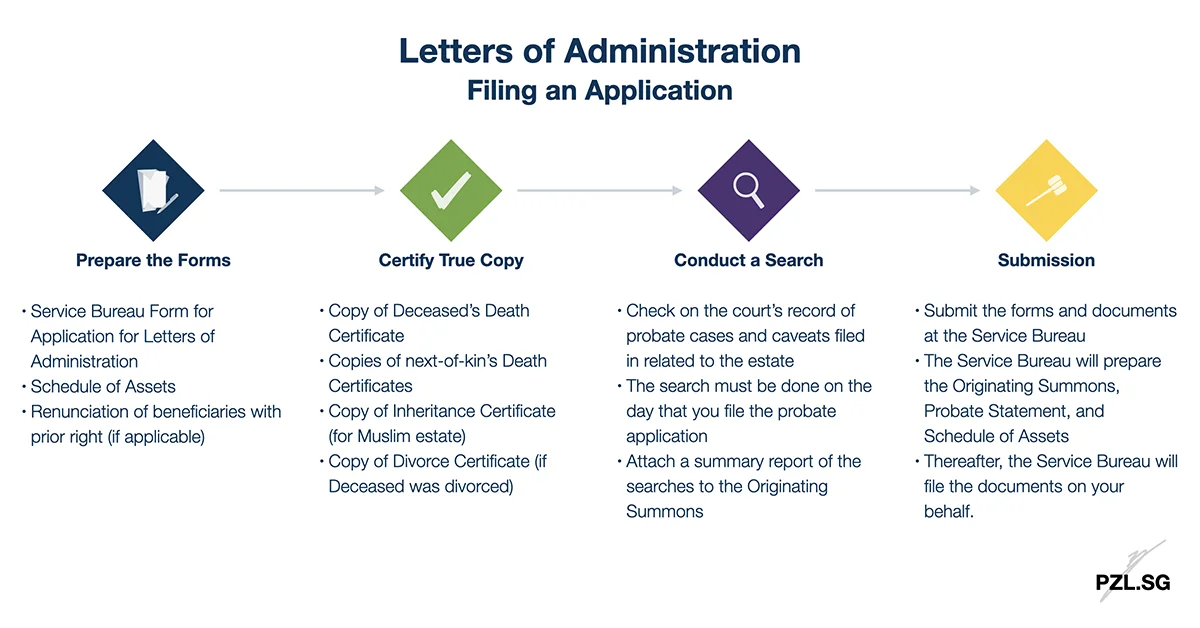
To begin with the application, we will prepare the Service Bureau Form for Application for Letters of Administration. Meanwhile, we also need to attend before a solicitor to certify as true copy for the supporting documents, e.g. Death Certificate.
Afterwards, we will conduct a check on the court’s record of probate cases and caveats filed in relation to the estate. For this purpose, it can be done at LawNet & CrimsonLogic Service Bureau.
It is important to realise that you need to make the search on the same day as the probate application, and for the present year. Correspondingly, you need to attach the summary report of the searches to the Originating Summons. This is together with the full report of any existing case or caveat.
Given that you have provided all the required documents, the Service Bureau will file the documents on your behalf.
Part 3.2: After You have submitted an application for Letters of Administration
On condition that the application is in order, the Court will
- accept the documents;
- assign a Family Court Probate (FC/P) number to the application; and
- fix a hearing date.
Thereupon, you may collect the accepted documents from the Service Bureau. Without delay, we need to prepare the Supporting Affidavit, and Administration Oath.
Part 3.3: The Supporting Affidavit
Above all, you need to prepare and file the Supporting Affidavit, and Administration Oath within 14 days of filing the application (Part 3.1).
To do this, we will prepare the Supporting Affidavit with a paragraph regarding the Schedule of Assets. Following that, we need to
- Affirm the Supporting Affidavit, and Administration Oath before a Commissioner for Oaths;
- File the Supporting Affidavit, and Administration Oath at the Service Bureau;
- Collect the accepted Supporting Affidavit, and Administration Oath from the Service Bureau.
The Court will grant the application in time to come. At this point, we will wait for the letter from the court regarding the Request to Extract the Grant.

Part 3.4: Extract the Grant
We need to prepare the Service Bureau form for the Request to Extract the Grant. In like fashion, we need to conduct a check on the court’s record of probate cases and caveats filed in relation to the estate. Likewise, we need to attach a summary report to the Request before submission. This process is similar to the one we did in Part 3.1.
In due time, the Court will process the Request and issue the Grant. Finally, you may collect the Grant from the Service Bureau.
In sum, this process takes approximately three to six months, depending on its complexity. Besides, this process could be extended if the documents are not in order. Thus, dying without a Will means that your beneficiaries will not inherit your estate promptly.
Trivia: Letters of Administration will not be granted to more than four people for the same estate.
Part 4: Who are the beneficiaries? And how much is their entitled share?
After the Court has issued the Grant, the administrator (i.e. the appointed next of kin) may bring it to the various institutions to realise the assets. For the most part, he is responsible to administer the estate. In reality, these are some of the administer’s duties:
- Pay off the liabilities for the Deceased;
- Pay for the funeral and other expenses;
- Distribute the balance according to the Intestate Succession Act (Cap. 146) (for non-Muslim estates); or
- Distribute the balance in accordance with Muslim law (for Muslim estates)
As you will agree, you have no say over how to manage your estate when you die without a will. Moreover, can you trust the administrator with your life savings?
Part 5: Should You rely on the Administrative Process?
After all, it sounds easy to leave the world without a word. Despite that, we should spare a thought for those who survives us. This is so as to prevent unnecessary dispute over your estate distribution.
In any case, the Intestate Succession Act is the law’s attempt to create a fair distribution on your estate. But
What if there is an unintended beneficiary? And will the law leave out someone who You care for?
In either case, dying without a Will feels like an irresponsible action.
Checklist:
- Is dying without a Will fair to your loved ones?
- Make an insurance nomination for all your insurance policies.
- Draft a Will today.
Reference:
Intestate Succession Act (Chapter 146)
Probate And Administration Act (Chapter 251)
First Published: 22 May 2019
Last Updated: 6 May 2020


Leave a Reply