If financial independence is the destination, then cash flow is the engine that takes you there. Many people focus heavily on how much they earn, but not enough on how much they spend. In cash flow planning, it is essential for you to understand your relationship with money and how money moves through your life. When you gain clarity and control, you reduce financial stress and enjoy greater peace of mind. With this in mind, let’s explore how to analyse your cash flow and how to improve it today.
Table of Contents:
- Why Cash Flow Matters
- The 3 Components of Cash Flow
- Assessing Your Financial Health
- Strategies to Manage Your Cash Flow
- Final Thoughts
One Minute Summary:
- Understanding your personal cash flow is the foundation of financial planning. It helps you to gain clarity on where your money comes from, where it goes, and how much you truly save each month.
- Understanding the four types of income helps you to build stability and reduce dependence on a single source.
- Categorising your expenditure helps you to identify what is essential, what can be optimised, and what is purely lifestyle-driven.
- A healthy cash flow plan priorities essentials, reduces unnecessary fixed costs and intentionally controls discretionary spending. This enables you to increase your surplus without necessarily earning more.
Part 1: Why Cash Flow Matters
There are five key reasons why understanding your cash flow is crucial for long-term financial stability.
- Cash flow reveals the reality of your money habits. For example, are you struggling to save consistently?
- After understanding your financial health, you can design an effective budget and implement spending control measures. For instance, it could be to reduce discretionary expenditure by $100 each month for better savings.
- Clarity allows deeper financial planning. For example, you may wish to save $2,000,000 by age 55.
- Being in control of your money reduces anxiety and prevents you from accumulating unhealthy debt.
- And finally, healthy cash flow habits compound over time, supporting you to make wiser life decisions.
Part 2: The 3 Components of Cash Flow
A typical cash flow comprises:
- Cash Inflow (Income): Money you receive or enters your account.
- Cash Outflow (Expenditure): Money you spend or exits your account.
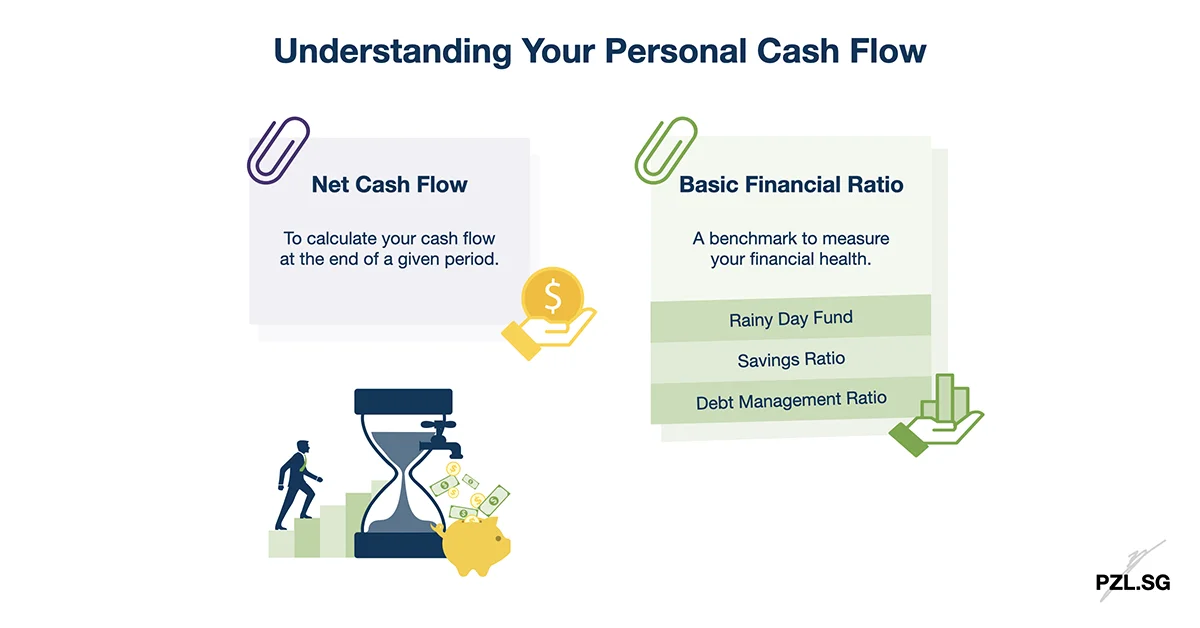
- Net Cash Flow: The difference between income and expenditure.
Let’s study these in detail.
Part 2.1: Income
There are four types of income:
- Active Fixed Income
- Active Variable Income
- Passive Fixed Income
- Passive Variable Income
Understanding the different types of income helps you to assess stability, risk, and your pathway towards financial independence.
Part 2.1.1: Active Fixed Income
Active fixed income is the money you earn by exchanging your time and skillset for a stable and predictable amount. For most people, this forms the backbone of their cash flow because it is consistent and dependable.
Example: Salary earned from employment
Part 2.1.2: Active Variable Income
Active variable income also requires active effort. However, the amount fluctuates. If most of your income comes from an active variable income, your cash flow plan should include a larger buffer to cope with the fluctuations.
Example: Performance bonuses, commission-based income, project fees
Part 2.1.3: Passive Fixed Income
Passive fixed income requires little-to-no effort and provides stable and predictable cash flow. This type of income is a key building block of financial independence. This is because it is stable and continues even after you stop working.
Example: CPF LIFE payouts, coupon payments from bonds, insurance annuity plans
Part 2.1.4: Passive Variable Income
Passive variable income also requires little-to-no effort. However, the amount varies depending on factors such as market conditions or performance. Given the uncertainty, you should not rely on this income for essential expenditure.
Example: Dividends, REIT distributions, royalties
Summary Table on the 4 Types of Income
| Active Fixed Income | Active Variable Income | Passive Fixed Income | Passive Variable Income | |
|---|---|---|---|---|
| Effort | Requires active effort | Requires active effort | Little-to-no effort | Little-to-no effort |
| Consistency | Consistent | Variable | Consistent | Variable |
| Predictability | Predictable | Less predictable | Predictable | Less predictable |
| Example | Salary from employment | Performance bonus | CPF LIFE payout | Dividends |
Part 2.2: Expenditure
There are three main types of expenditure:
- Non-Negotiable Essential Expenditure
- Negotiable Essential Expenditure
- Discretionary Expenditure
Understanding the different types of expenditure helps you identify your money must go, where it could go, and where it should not go.
Part 2.2.1: Non-Negotiable Essential Expenditure
Non-negotiable essential expenditure is the money you need to spend for basic survival. This amount is often fixed and difficult to reduce. Since they are essential, you will usually pay them first.
Example: Mortgage payment, loan repayment, insurance premium, taxes
Part 2.2.2: Negotiable Essential Expenditure
Negotiable essential expenditure is the money you need for functional living. This amount can be adjusted through changes in behaviour, consumption habits, or lifestyle choices.
Example: Groceries, transportation (beyond basic needs), household supplies
Part 2.2.3: Discretionary Expenditure
Discretionary expenditure is optional. It enhances lifestyle, comfort, enjoyment, or convenience but does not affect survival or functional living.
Example: Shopping, holidays, gifts, entertainment
Summary Table on the 3 Types of Expenditure
| Non-Negotiable Essential Expenditure | Negotiable Essential Expenditure | Discretionary Expenditure | |
|---|---|---|---|
| Nature | Fixed | Variable | Variable |
| Required For | Basic survival | Functional living | Lifestyle |
| Example | Mortgage | Transportation (beyond basic) | Holidays |
Part 2.3: Net Cash Flow
Net cash flow is the difference between your total income and your total expenditure. That is,
Net Cash Flow = Total Income – Total Expenditure
- Positive Net Cash Flow: You earn more than you spend. A consistent positive net cash flow is the foundation of financial stability and future growth.
- Negative Net Cash Flow: You spend more than you earn. This is a warning sing of poor financial management.
Understanding your net cash flow is a reality check. Some may feel relieved after discovering their unused surplus. While other may feel shocked to realise why their bank balance never grows.
Part 3: Assessing Your Financial Health
Understanding your cash flow is the first step. To assess your long-term financial sustainability, there are three key financial metrics to look at.
- Basic Liquidity Ratio (Emergency Fund)
- Savings Ratio
- Debt Management Ratio
Part 3.1: Basic Liquidity Ratio (Emergency Fund)
Basic Liquidity Ratio = Cash / Total Monthly Expenditure
Guideline: Maintain 3 to 6 months of total monthly expenditure in cash or cash-equivalent instruments.
- Less than 3 months: You may face financial stress during emergencies and risk taking on bad debt.
- More than 6 months; Excess cash may be sitting idle, losing value due to inflation.
Part 3.2: Savings Ratio
Savings Ratio = Monthly Surplus / Take-Home Income
Guideline: Save 20% to 30% of your take-home income consistently
- Below 10%: Your lifestyle may be consuming too much of your income.
Part 3.3: Debt Service Ratio
Debt Service Ratio = Total Loan Repayment / Take-Home Income
Guideline: Keep this ratio below 35%
- Above 40%: Cash flow becomes tight. This reduces your ability to save or manage emergencies.
You must remember that repayments are usually non-negotiable. Therefore, keeping the amount low protects your cash flow.
Table: Basic Financial Ratio
| Basic Liquidity Ratio | Savings Ratio | Debt Service Ratio | |
|---|---|---|---|
| Purpose | Measures readiness for emergencies | Assess your ability to save and build wealth | Assess your ability to handle debt obligation |
| Formula | Cash / Total Monthly Expenditure | Monthly Surplus / Take-Home Income | Total Loan Repayment / Take-Home Income |
| Guideline | 3 to 6 months of total monthly expenditure in liquid cash | 20% to 30% of take-home income | Below 35% of take-home income |
Part 4: Strategies to Manage Your Cash Flow
After understanding your cash flow, here are some actionable steps to manage and improve it.
Part 4.1: Track Everything!
Track all income and expenses relentlessly for at least 60 to 90 days. Real data reveals spending patterns, wasteful habits, and opportunities for improvement. A good way to start is to look at your bank and credit card statements and categorise these expenses into:
- Non-negotiable essential expenditure,
- Negotiable essential expenditure, and
- Discretionary expenditure.
Part 4.2: Align Spending with Your Values
After tracking your expenses, ask yourself:
- Does this spending bring you closer to your goals?
- What is the minimum you need for basic survival?
- How much does a functional lifestyle cost?
- What does it mean to live a comfortable lifestyle?
These questions help you to design a cash flow that is aligned with your priorities.
Part 4.3: Create a Monthly Budget
A simple and effective guideline for a budget is:
- 50% to 55% for essential expenditure (both non-negotiable and negotiable),
- 20% to 25% for discretionary expenditure, and
- 20% to 30% for savings and debt repayment
When it comes to budgeting, I prefer to use automation for consistency. Here is how I do it: How to create a Monthly Budget
Part 4.3: Conduct Regular Reviews
Review your financial health at least once every quarter. Consistent refinement strengthens your cash flow and gradually transforms it into a powerful engine for building financial independence.
Part 5: Final Thoughts
Understanding your personal cash flow is more important than knowing how to earn a high income. At the end of the day, what you keep matters more than what you earn, and what you do with that matters most.
A strong grasp of your cash flow reveals the experiences you value, your level of discipline, and whether you are moving closer, or further away from financial independence.
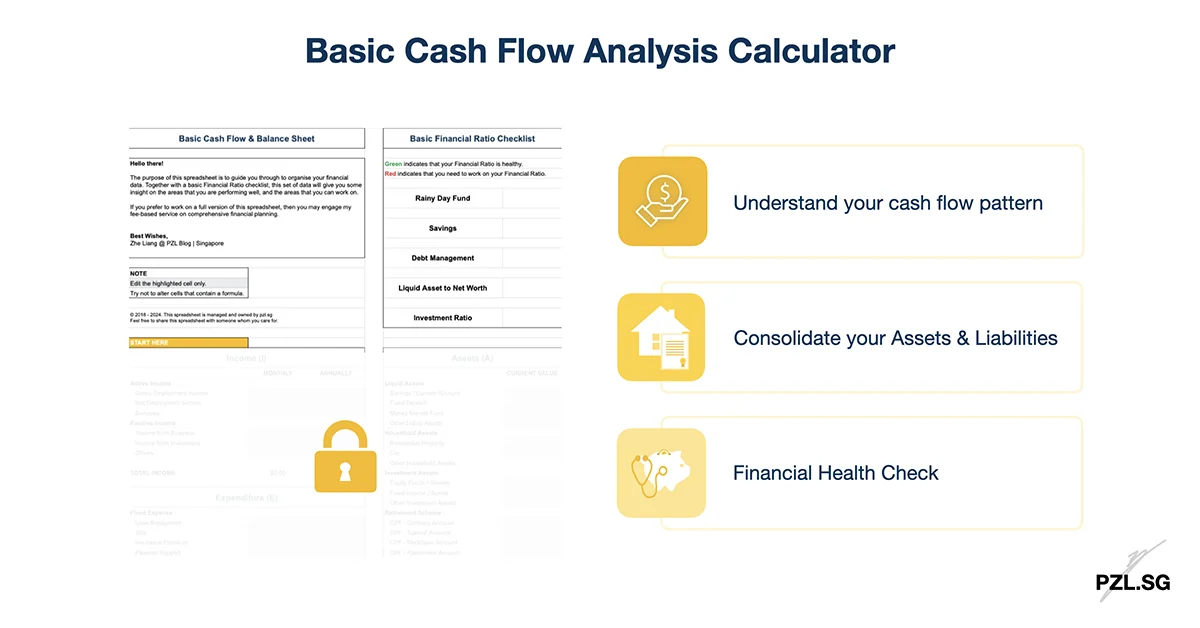
Are you looking for a reliable Cash Flow Analysis Calculator?
First Published: 24 April 2019
Last Updated: 8 March 2021


Leave a Reply