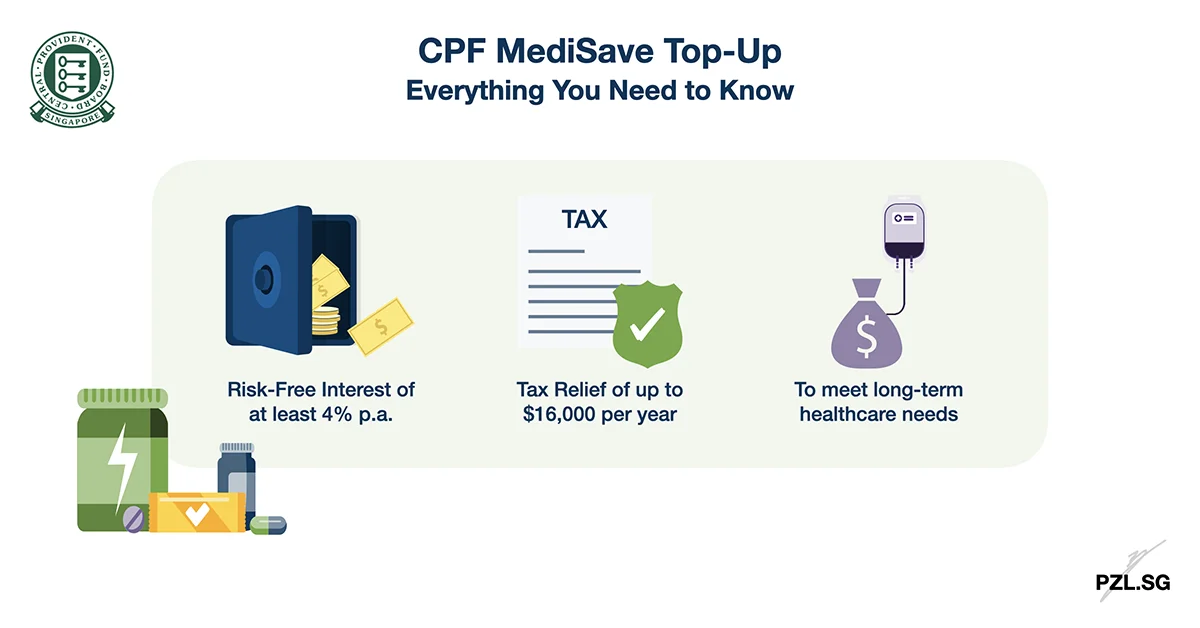
CPF MediSave top-up is one of the most tax-efficient and stable ways for Singaporeans to build a robust medical safety net. Whether you are an employee, self-employed, or planning for your parents’ retirement needs, these voluntary MediSave top-ups earn a high risk-free interest of at least 4% per annum. Moreover, you can also enjoy up to $16,000 in tax relief each year. In this article, let’s learn how MediSave works, how MediSave top-ups benefit you, and practical strategies to optimise both your healthcare and retirement needs.
🎥 Prefer watching? Check out the video version of this post.
Table of Contents:
- What is CPF MediSave
- What is MediSave Top-Up
- Understanding the Basic Healthcare Sum (BHS)
- Benefits of MediSave Top-Ups
- Limitations of MediSave Top-Ups
- Maximising your CPF Top-Ups
- MediSave Top-Ups vs RSTU
- Final Thoughts
- Step-By-Step Guide
One Minute Summary:
- MediSave top-ups allow you to top up your MediSave Account.
- The voluntary contributions to your MediSave Account earn a risk-free interest of at least 4% per annum, and up to 6% per annum.
- You can enjoy up to $16,000 in tax relief on your voluntary contributions made to your own and loved ones’ MediSave Accounts.
- After reaching the Basic Healthcare Sum ($79,000 in 2026), excess contributions and interest from your MediSave Account will flow into either your SA/RA or Ordinary Account. This helps you build your retirement savings.
- Top-up monies are locked in for healthcare needs and cannot be withdrawn as cash.
- MediSave top-ups may be suitable if you wish to build a robust medical safety net to afford essential healthcare and insurance coverage.
Part 1: What is CPF MediSave
Within CPF, your CPF savings are divided into three accounts:
- Ordinary Account (OA) – housing, education, investment
- Special Account (SA) – retirement savings
- MediSave Account (MA) – healthcare-related expenditure, certain insurance schemes
A fourth account, the Retirement Account (RA), is created automatically when you turn 55.
Part 1.1: What MediSave is used for
You can use your MediSave to pay for a wide range of healthcare expenses, e.g. inpatient hospital bills, outpatient treatments for chronic conditions such as diabetes and hypertension. You can also use MediSave to pay for insurance policies such as
- MediShield Life – Singapore’s basic health insurance scheme
- Integrated Shield Plan – Enhanced coverage to cover non-subsidised care
- ElderShield / CareShield Life – Singapore’s severe disability insurance scheme
- Long-Term Care Supplements – Enhanced coverage to provide higher disability payouts
By having a dedicated pool of savings in your MediSave Account, it ensures that you will never struggle to afford essential healthcare or insurance coverage.
Part 2: What is MediSave Top-Up
If you are an employee, you already contribute to MediSave through CPF contributions. For example, workers below age 55 contribute a total of 37% of wages as CPF contributions (20% from employee, 17% from employer). These CPF contributions are allocated into your CPF accounts according to the CPF allocation rates based on age.
If you are a self-employed person, you must make mandatory MediSave contributions under the Self-Employed Scheme.
Table: CPF Allocation Rate to OA/SA/RA/MA based on Age
| Your Age | OA | SA/RA | MA |
|---|---|---|---|
| 35 & Below | 62.17% | 16.21% | 21.62% |
| Above 35 to 45 | 56.77% | 18.91% | 24.32% |
| Above 45 to 50 | 51.36% | 21.62% | 27.02% |
| Above 50 to 55 | 40.55% | 31.08% | 28.37% |
| Above 55 to 60 | 36.94% | 30.76% | 32.3% |
| Above 60 to 65 | 14.90% | 40.42% | 44.68% |
| Above 65 to 70 | 6.07% | 30.30% | 63.63% |
| Above 70 | 8% | 8% | 84% |
Regardless of your employment type, building up your healthcare savings can be slow – especially with rising medical costs and longer life expectancy. Through voluntary MediSave top-ups, it enables you to
- Supercharge your medical savings
- Earn high risk-free interest of at least 4% per annum
- Prepare for future healthcare needs
- Pay insurance premiums
- Enjoy substantial tax savings of up to $16,000 per year.
This makes MediSave top-ups an effective financial planning tool for you.
Part 3: Understanding the Basic Healthcare Sum (BHS)
The amount of cash top-ups you can make depends on your current MediSave balance and the prevailing Basic Healthcare Sum. The Basic Healthcare Sum (BHS) is the maximum amount you can have in your MediSave Account. In 2026, the Basic Healthcare Sum is $79,000. According to CPF Board, this amount represents the estimated savings you need in MediSave to cover basic subsidised healthcare needs in old age.
If you are below 65 years old, the Basic Healthcare Sum will be adjusted annually to keep pace with the increasing healthcare costs. This process also ensures that your healthcare savings will remain relevant for your cohort when you reach retirement age. Once you turn 65, your Basic Healthcare Sum is locked in for life.
What happens after you reached the Basic Healthcare Sum?
When your MediSave reaches the Basic Healthcare Sum,
- You cannot perform voluntary top-ups to your MediSave Account
- Mandatory CPF contributions and interest overflow into your Special Account (if you are below age 55) or Retirement Account (if you are age 55 or above)
- After your SA/RA reaches the prevailing Full Retirement Sum (FRS), this overflow goes into your Ordinary Account and can be withdrawn after you turn 55.
This overflow mechanism allows your MediSave top-ups to indirectly boost your retirement savings over time.
Part 4: Benefits of MediSave Top-Ups
Topping up your MediSave Account offers several compelling advantages:
- Build Your Medical Safety Net Early
- Pay for Medical Expenses, Insurance Premium
- High Risk-Free Interest Rate
- Tax Relief
- Matched MediSave Scheme (MMSS)
Part 4.1: Build Your Medical Safety Net Early
By topping up your MediSave Account early, you accelerate the effect of compound interest. This enables you to build a strong healthcare buffer and reduce future out-of-pocket medical expenses. With a robust medical safety net, it protects your retirement income from being drained by medical bills. This is especially important as medical needs and insurance premiums increase significantly with age.
Part 4.2: Pay for Medical Expenses, Insurance Premium
MediSave can be used to pay for various healthcare-related expenses and insurance premium. These include:
- Hospitalisation bill, surgeries, certain outpatient treatments
- Insurance premiums for health insurance policies such as MediShield Life, Integrated Shield Plan
- Insurance premiums for long-term care insurance policies such as ElderShield, CareShield Life, and its related supplements.
Part 4.3: High Risk-Free Interest Rate
Savings in the MediSave Account earns a base risk-free interest of 4% per annum. Additionally, CPF provides extra interest on the first $60,000 of your combined balances.
| Age | Base Interest (Per Annum) | Additional Interest (Per Annum) | Total Interest (Per Annum) |
|---|---|---|---|
| Below 55 | 4% | 1% on the first $60,000 combined CPF balances, capped at $20,000 for OA | Up to 5% |
| 55 and above | 4% | 2% on the first $30,000, and 1% on the next $30,000 combined CPF balances, capped at $20,000 for OA | Up to 6% |
This is one of the highest risk-free returns available in Singapore.
Let’s consider the following two examples to illustrate the power of compound interest:
| How much you save | How long you save | How much interest you get | Total savings at the end of the period |
|---|---|---|---|
| $100 monthly | 15 years | 0.45% per annum (based on the average banks’ interest rate from May 2025 to July 2025) | $18,617 |
| $100 monthly | 15 years | At least 4% per annum | Over $24,000 |
As can be seen, savings in the MediSave Account enjoy more returns from compounding. In fact, if you continue to save for another 10 years, the amount grows to more than $50,000.
Part 4.4: Tax Relief
Each year, you can enjoy tax relief of up to $16,000 when making cash top-ups to your own or your loved ones’ MediSave Account:
- Up to $8,000 tax relief for topping up your own MA
- Up to $8,000 tax relief for topping up your loved ones’ MA
Important Notes:
- As the giver, you will enjoy the tax relief, while the recipient will not.
- The amount of tax relief depends on the actual top-up amount made.
- The $8,000 cap is shared with SA/RA cash top-ups.
- Your total personal income tax relief cap is $80,000 per year.
- CPF Board will inform IRAS automatically. So you do not need to file or claim tax relief.
Eligible loved ones include:
- Parents and parents-in-law
- Grandparents and grandparents-in-law
- Spouse and siblings (must have an annual income of $8,000 or less in the previous year, or is disabled)
Part 4.5: Matched MediSave Scheme (MMSS)
Under the Matched MediSave Scheme (MRSS), eligible seniors with low MediSave savings can enjoy matching grants of up to $1,000 in each calendar year. Cash top-ups that receive the matching grants will not receive tax relief. Despite that, any contributions above the matched grant will continue to attract tax relief.
Part 5: Limitations of MediSave Top-Ups
Here are some limitations of topping up your MediSave Account:
- Locked-In for Healthcare Needs
- Top-Up Caps
- Top-Ups are Treated as Gifts
- Special Considerations for Self-Employed Persons
Part 5.1: Locked-In for Healthcare Needs
Cash top-ups made to your MA are irreversible. As a result, you cannot reverse the transfer or to withdraw them as cash. Instead, you can only use these savings via the respective Medisave withdrawal limits and rules.
Part 5.2: Top-Up Caps
The Basic Healthcare Sum is the maximum amount you can have in your CPF MediSave Account. Once you have reached the Basic Healthcare Sum,
- You cannot perform voluntary top-ups to your MediSave Account
- Mandatory CPF contributions and interest overflow into your Special Account (if you are below age 55) or Retirement Account (if you are age 55 or above)
- After your SA/RA reaches the prevailing Full Retirement Sum, this overflow goes into your Ordinary Account and can be withdrawn after you turn 55.
Part 5.3: Top-Ups are Treated as Gifts
Money topped up for your loved ones belong to them. When they pass on, the money is distributed based on their CPF nomination, not returned to you.
Part 5.4: Special Considerations for Self-Employed Persons
As a self-employed person, you
- Must first fulfil your mandatory MediSave contributions (either in full or on GIRO monthly deductions) before you are allowed to make top-ups to yourself or your loved ones
- Cannot use voluntary top-ups to offset the mandatory MediSave payable.
This ensures that you prioritise the mandatory contributions.
Part 6: Maximising Your CPF Top-Ups
Part 6.1: Top Up Early in the Year
CPF interest is computed monthly.
- Cash top-ups earn interest from the following month.
- CPF transfers earn interest immediately in the month of transfer.
Earlier top-ups mean more compounding. For example, topping up in January instead of December gives up to 20% more interest over 10 years.
Part 6.2: Regular Small Top-Ups
You can make voluntary contributions via monthly GIRO transfers to build savings gradually. This encourages consistently savings habits by making cash flow planning easier.
Part 6.3: Leverage on the Matched MediSave Scheme (MMSS)
If you or your loved one is eligible for the MMSS, top up the MediSave Account to receive the matching grant first. By doing so, the Government will match every dollar of cash top-ups made. This is up to a limit $1,000 per year. You can continue to enjoy tax relief beyond the matching cap.
Let’s take the case where you make a cash top-up of $8,000. The first $1,000 will attract the matching grant while tax relief will be given to the remaining $7,000.
Part 7: MediSave Top-Ups vs RSTU
Top-ups made to your MediSave Account and SA/RA shares the same tax relief of up to $8,000 each year. As a result, a common question I get is – which account should I top up first? Well, it depends on your goals.
Part 7.1: MA top-ups are suitable if you prioritise meeting healthcare needs
Topping up your MediSave Account helps meet healthcare needs. These savings can be used for medical expenses, insurance premiums, and your family’s healthcare costs. As a result, your cash top-ups help to negate some of these MediSave deductions that occur throughout the year.
After reaching the Basic Healthcare Sum ($79,000 in 2026), excess contributions and interest will flow to your SA/RA. This helps to build your retirement savings eventually.
Part 7.2: SA/RA top-ups are suitable if you prioritise retirement savings
Meanwhile, topping up your SA/RA via the Retirement Sum Topping-Up Scheme provides a predictable lifelong income under CPF LIFE. This is ideal if you prioritise retirement savings and want to mitigate longevity risk (outliving your savings). Consider transferring funds from your Ordinary Account to your SA/RA if you don’t foresee any needs for the savings in your Ordinary Account.
Topping up your SA/RA first can provide more tax relief over time. Once you reach the Full Retirement Sum, there is no further tax relief. Moreover, working contributions and interest earned remain in your SA/RA. This helps to meet the yearly increase in the Full Retirement Sum.
Part 8: Final Thoughts
Personally, I find MediSave top-ups to be one of the most underrated and often ignored strategies in CPF optimisation. Some of the reasons why this occur is because you may have liquidity concerns or feel that these savings are restricted to healthcare use only. However, a well-funded MediSave Account
- Reduces the chance of healthcare becoming a financial burden
- Supports both your loved ones’ and your healthcare needs without dipping into cash
- Protects your retirement savings from medical expenses
- Offers peace of mind as you age.
We all know that healthcare costs are expensive in Singapore, especially in old age. What’s more, we often underestimate the future healthcare cost. After all, it is not straightforward to project long-term care needs, chronic illnesses, or rising medical inflation. It is not true that we will always remain healthy forever!
Once your MediSave reaches the prevailing Basic Healthcare Sum, any excess contributions and interest will automatically flow into your SA/RA. This helps you to build your retirement savings for CPF LIFE. Eventually, you will be able to withdraw these excess contributions as cash from age 55, once your SA/RA has met the Full Retirement Sum (FRS).
Of course, MediSave top-ups are not for everyone. It works best if you
- Expect rising medical needs
- Want high risk-free compounding interest
- Want tax relief
- Are self-employed with variable income
- Are aiming to fully utilise the Matched MediSave Scheme
Now, here is how you can start building your medical safety net: If you are below 55, top up your MediSave Account to the prevailing Basic Healthcare Sum. Once that is done, any excess contributions will flow into your Special Account to build your retirement savings.
After your MediSave Account has reached the prevailing Basic Healthcare Sum, wait for the BHS adjustments at the start of the year. This is your window to perform additional top-ups and enjoy tax relief before your employment contributions (if any) are credited. Whenever there are MA deductions, e.g. medical expenses or insurance premiums, you can continue making additional top-ups to enjoy tax relief. This helps you build a robust medical safety net to manage your healthcare expenses in old age.
Building a robust medical safety net is one of the three core pillars in retirement. In addition, you should work towards having a fully paid home and a reliable retirement income stream. One of the best lifelong insurance annuity plans you can consider is CPF LIFE. You can also supercharge your SA/RA through the CPF Retirement Sum Topping-Up Scheme.
Part 9: Step-by-Step Guide
CPF members can use one of the following two methods to perform voluntary cash top-ups to their MediSave Account. Most cash top-ups via PayNow QR or OCBC Digital (CPF Mobile app only) will be reflected in your CPF account almost instantly.
Part 9.1: Cash Top-Up via CPF Mobile App
- Log in using your Singpass
- Tap on the menu icon on the top left corner
- Tap on “Top Up”, then “MediSave”
- Submit your application and make your payment immediately via PayNow QR
Part 9.2: Cash Top-Up via CPF Website
- Go to https://www.cpf.gov.sg/member/tools-and-services/forms-e-applications/top-up-medisave-account
- Log in using your Singpass
- Select the Recipient Details – either “Myself” or “My loved one”
- Under Top-up details, enter the amount you wish to top up. (You can also see the amount you can top up at this screen.)
- Choose your preferred cash top-up method. You can top top via PayNow QR or via GIRO
Reference: Top Up Your MediSave Account to Save More for Healthcare Needs


Leave a Reply