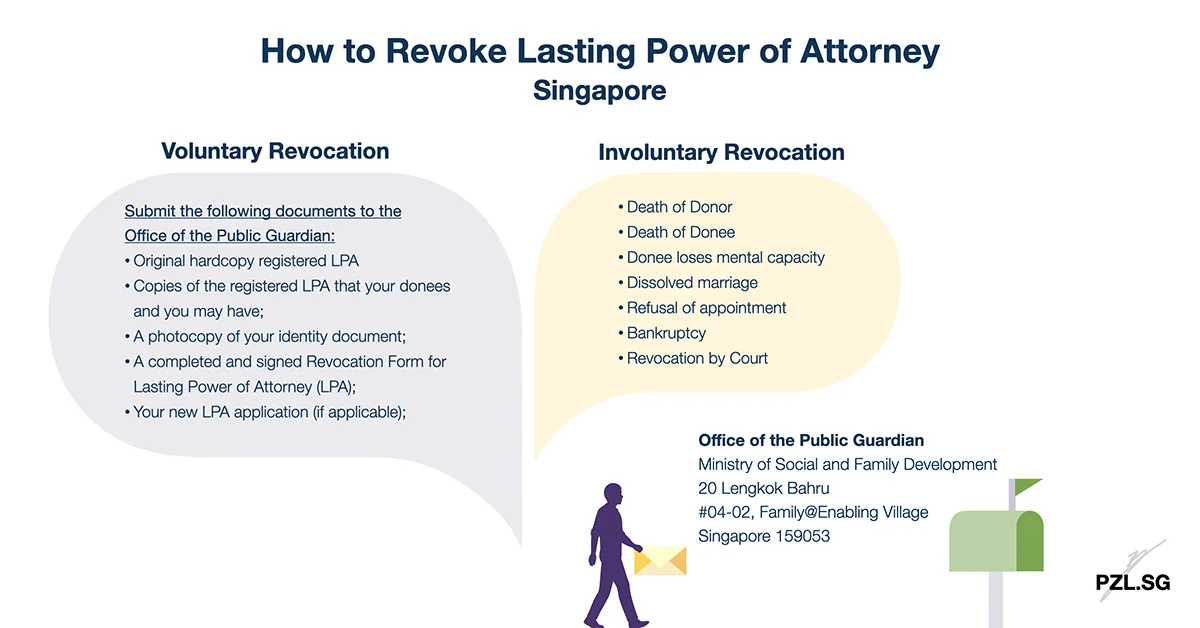
As the donor, you may revoke your lasting power of attorney (LPA) so long as you have the mental capacity to do so. At the same time, there are other situations when your LPA may become revoked as well. With this in mind, let’s list each situation and understand how to revoke a lasting power of attorney in Singapore.
Table of Contents:
- What is Lasting Power of Attorney (LPA)
- Automatic Revocation
- Voluntary Revocation
- Revocation of Personal Welfare
- Revocation of Property and Affairs
- Revocation by Court
- Conclusion
One Minute Summary:
- Summing up, your lasting power of attorney may be revoked either on a voluntary or an involuntary basis.
- Above all, you may revoke your own LPA so long as you have the mental capacity to do so.
- Otherwise, you will need to count on one or more of the listed situations to revoke your LPA.
Part 1: What is Lasting Power of Attorney (LPA)
In essence, a Lasting Power of Attorney (“LPA”) is a legal document to allow you (the “donor”) to voluntarily appoint one of more persons (the “donee(s)”) to make certain decisions on your behalf if you lose mental capacity one day. Generally, you may authorise the donee to act in either or both of the following two broad areas:
- Personal Welfare, i.e. relates to your daily activities such as where you should live;
- Property and Affairs, i.e. relates to your financial matters such as how to manage your property.
Part 2: Automatic Revocation
Obviously, as the donor, your lasting power of attorney will be revoked upon your death. Thereafter, your donee will not be able to manage your assets on your behalf.
If you prefer to have someone to manage your estate after your death, then you should appoint an executor by drafting a Will. By the same token, if you prefer to distribute your insurance proceeds and CPF monies more efficiently after your death, then you should complete an insurance nomination and a CPF nomination. To point out, the latter is imperative as that is the only way to distribute your CPF monies according to your wishes after your death.
Part 3: Voluntary Revocation
In truth, you may encounter times when you wish to revoke the powers given to your donees. For example, you discovered that your appointed donee has an integrity related issue. Under those circumstances, you may revoke your lasting power of attorney and to appoint someone else instead. In order to do this, you must have the mental capacity to proceed with the revocation.
Part 3.1: What do You need to submit?
For this purpose, you will need to inform the Office of the Public Guardian (OPG) in writing. In detail, you will need to submit the following documents:
- Original hardcopy registered LPA (this is applicable only if you have registered the LPA with the OPG before 1 August 2019);
- Copies of the registered LPA that your donees and you may have;
- A photocopy of your identity document;
- A completed and signed Revocation Form for Lasting Power of Attorney (LPA);
- Your new LPA application (if applicable);
For the most part, you should take reasonable steps to inform each donee that you are revoking your LPA. Otherwise, your donees may not know that you have revoked your lasting power of attorney. Under those circumstances, they may end up making decisions on your behalf if you become mentally incapacitated. In order to prevent such a conflict, your donee(s) will also need to acknowledge your revocation by signing on the same Revocation Form.
Finally, you will also need to pay a revocation fee of S$25 via Ministry of Social and Family Development’s e-Services portal.
Q. What if you are unable to obtain the donee’s signature?
In this case, you will need to attach evidence to prove that you have made reasonable effort to notify your donee of your intention to revoke the lasting power of attorney. For example, you may submit a registered mail receipt together with the rest of the documents in Part 3.1.
Part 3.2: How to submit the documents?
If you are submitting a new LPA application together with the revocation for the existing LPA, then you may submit the documents to the Office of the Public Guardian by post. That is to mail the documents to
Office of the Public Guardian
Ministry of Social and Family Development
20 Lengkok Bahru
#04-02, Family@Enabling Village
Singapore 159053
On the other hand, if you are revoking your existing LPA only, then you will need to submit the documents to the Office of the Public Guardian in-person during office hours.
Part 4: Revocation of Personal Welfare
To sum up, the donee’s appointment for personal welfare may become revoked under five scenarios.
Part 4.1: Death of donee
Firstly, the donee’s appointment will be automatically revoked upon the donee’s death.
Part 4.2: Loss of Mental Capacity
When your donee lacks the mental capacity to make decisions on your behalf, your LPA will be revoked.
Part 4.3: Dissolved Marriage
Thirdly, if the marriage between the donor and the donee is dissolved, then the donee’s appointment will be revoked. This is unless you (as the donor) have specifically state in the LPA that the donee shall continue to act on your behalf if you lose mental capacity.
Part 4.4: Refusal of Appointment
Although you may choose (almost) anyone to be your donee, your donee is not obliged to manage your affairs for you. If the donee refuses his appointment formally, then the LPA may become revoked as well.
Part 4.5: More than one Donee
Let’s take the case where the lasting power or attorney appoints two or more donees to act jointly. If one of the donee’s power has been revoked, then the entire LPA will be revoked. This is because all your donees have to agree on the decision and to act together. Given that none of the donees may act on his or her own, the joint appointment will be terminated.
However, what if you have appointed a replacement donee? In this situation, the replacement donee will take over the earlier donee’s role. Under those circumstances, your LPA will remain valid to that end.
Meanwhile, if there is one or more surviving donees appointed to act jointly and severally, then your LPA will remain valid as well.
Part 5: Revocation of Property and Affairs
In addition to the points mentioned in Part 4, there are two more situations when your LPA may become revoked.
Part 5.1: Bankruptcy
If your donee becomes bankrupt, then his power to manage your property and affairs will be revoked.
Part 5.2: Licensed Trust Company
Next, let’s look at the case when you appoint a licensed trust company to manage your property and affairs. In this case, its power to manage your property and affairs will be revoked when the trust company or its license has
- Lapsed;
- Been revoked;
- Liquidated;
- Wound-up;
- Dissolved; or
- Under judicial management.
Part 6: Revocation by Court
Finally, the court may also revoke your lasting power of attorney under three scenarios.
Part 6.1: Fraud
To demonstrate, what if you were induced to make an LPA under undue pressure? In that case, the court may exercise its powers to revoke the LPA.
Part 6.2: Best Interest
As a matter of fact, if your donee is not acting in your best interest, then the court make revoke the LPA as well.
Part 6.3: Misbehaviour
In similar fashion, if the donee is behaving in a way that contravenes his authority, then the court may revoke your LPA.
By and large, if the donee abuses his power, then he may face severe penalties under Section 42 of the Mental Capacity Act, e.g. fine or imprisonment.
Part 7: Conclusion
To conclude, your lasting power of attorney may not last forever. As I have noted earlier, there are so many situations to revoke a lasting power of attorney. For the most part, you would agree that most of these situations exist to protect you. Despite that, you shouldn’t be complacent to count on these measures alone. Therefore, you should always exercise due diligence when deciding who to handle your affairs if you lose mental capacity one day. If you are keen to make a lasting power of attorney, then check out my guide to learn more.


Leave a Reply