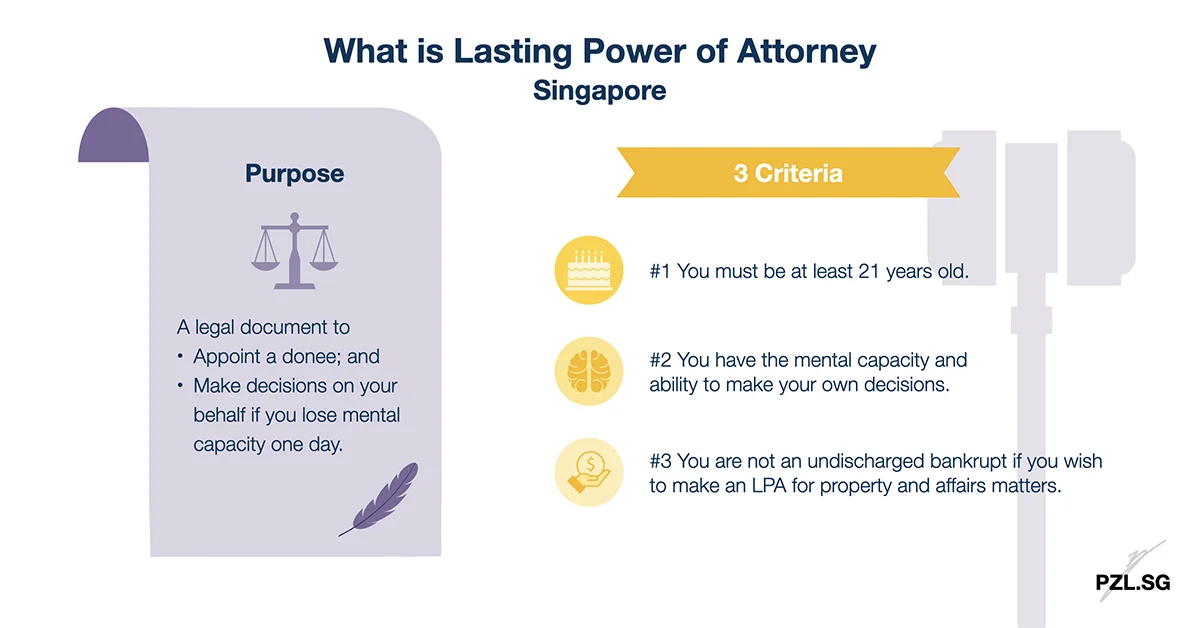
In essence, a Lasting Power of Attorney (“LPA”) is a legal document to appoint someone to make certain decisions on your behalf if you lose mental capacity one day. Given that power, we will want to find out how an LPA works, and whether the appointed person may abuse such power. With this in mind, let’s learn more about a lasting power of attorney in this post.
Table of Contents:
- What is Lasting Power of Attorney (LPA)
- Problems without a Lasting Power of Attorney
- Benefits of a Lasting Power of Attorney
- Types of Lasting Power of Attorney
- Who is involved in a Lasting Power of Attorney
- When is a Lasting Power of Attorney activated
- Should You complete a Lasting Power of Attorney?
One Minute Summary:
- A lasting power of attorney or an LPA allows you to appoint a trusted body to make decisions (related to your welfare) on your behalf if you lose mental capacity one day.
- All things considered, this is probably the simplest solution to ensure that you have someone to take care of your needs and in the way you want it to be.
- In order to make an LPA, you must be at least 21 years old, and has the mental capacity and ability to make your own decisions.
- For this purpose, there are two forms – LPA Form 1, and LPA Form 2.
- So long as you have the mental capacity to do so, you may revoke or to make changes to your LPA at anytime.
Part 1: What is Lasting Power of Attorney (LPA)
According to the Mental Capacity Act (Chapter 177A),
A lasting power of attorney is a power of attorney under which the donor confers on the donee authority to make decisions about the donor’s personal welfare, and/or property and affairs, when the donor no longer has capacity to make such decisions.
In other words, a lasting power of attorney is a legal document to allow you (the “donor”) to voluntarily appoint one or more persons (the “donee(s)”) to act on your behalf. Generally, you may authorise the donee to act in either or both of the following two broad areas:
- Personal Welfare, i.e. relates to your daily activities such as where you should live;
- Property and Affairs, i.e. relates to your financial matters such as how to manage your property.
For one thing, you need to grant explicit power to the donee before he or she is able to make certain decisions on your behalf. To illustrate, if you grant the donee on the power to make decisions for your personal welfare only, then this donee cannot make decisions for your property and affairs. This goes in the same way for the reverse case. Of course, you may also grant explicit power to the donee to manage both your personal welfare, as well as your property and affairs.
Part 2: Problems without a Lasting Power of Attorney
At this time, neurological diseases such as dementia are the fifth leading cause of disability in Singapore. According to the national statistics,
1 in 10 people above the age of 60 suffers from dementia.
In detail, this corresponds to approximately 82,000 people in 2018. In view of the rising life expectancy and ageing population, we may expect the number of people with dementia to double by 2030. Besides, you may also lose mental capacity because of a medical problem, e.g. stroke, coma, or an accident. Under those circumstances,
Who is going to make decisions and to manage your affairs on your behalf?
In any case, no one has the power to manage your affairs without your explicit permission. In fact, can you imagine how chaotic the world would be if anyone can decide on the direction for your medical treatment or to operate your bank accounts without your consent? Despite that power, making a lasting power of attorney is not the only solution to overcome this problem.
In the absence of an LPA, someone (e.g. a family member) has to apply to the Court to be appointed as a deputy. After receiving the Court’s approval, the deputy shall be authorised to make certain decisions on your behalf. As compared to a lasting power of attorney, the deputyship process is more expensive and takes a longer time to complete. Furthermore, there exists an uncertainty on whether this person (who is appointed as the deputy) will act in your best interest.
Q: Can I use a Will instead?
To point out, your Will is effective only upon death. Since you are still alive, your executors do not have the authority to administer your estate.
Part 3: Benefits of a Lasting Power of Attorney
In order to overcome some of the mentioned issues in Part 2, you may make a lasting power of attorney. On balance, this allows you to make a well-informed decision on who to select as your trusted proxy. Thereupon, this person shall become responsible for your decision-making if you lose mental capacity one day. Seeing that we will select this person after a careful deliberation, we avoid potential conflicts and stress in the future. As an illustration, your spouse and your parents may have an opposing view on where you should stay.
Part 4: Types of Lasting Power of Attorney
For this purpose, you may choose to complete either of the following two forms.
Part 4.1: LPA Form 1
Firstly, you may use an LPA Form 1 to grant one or two donees general powers with basic restrictions. As I have noted earlier, such power may be for your personal welfare, and/or property and affairs.
Fun Fact: 98% of the Singapore Citizens who have made an LPA used Form 1.
Part 4.2: LPA Form 2
Secondly, you may engage a lawyer to draft an LPA Form 2 if you prefer to grant customised and specific powers to your donees. To demonstrate, you may wish to give specific powers or to restrict the execution on certain types of transaction. By the same token, you may use an LPA Form 2 when you face limitations in an LPA Form 1, e.g. to appoint more than two donees.

Part 5: Who is involved in a Lasting Power of Attorney
Part 5.1: You (as the donor)
By and large, you must
- Be at least 21 years old;
- Have the mental capacity and ability to make your own decisions;
- Not be an undischarged bankrupt if you wish to make an LPA for property and affairs matters.
Part 5.2: The Donee(s)
Next, the appointed donee needs to be at least 21 years old as well. In addition, the donee
- For personal welfare must be an individual.
- For property and affairs cannot be someone who is legally bankrupt.
At the same time, you may also appoint a licensed trust company as the donee for property and affairs.
If you wish to appoint more than one donee, then you need to decide on how they will make decisions on your behalf; that is
- Jointly: On this occasion, all your donees have to agree on the decision and to act together. To put it another way, neither of the donees may act on his or her own. For the same reason, this joint appointment will be terminated when any of the donees is no longer able to act.
- Jointly and severally: In this situation, your donees may make decisions together or separately. To this end, both types of decisions are valid.
Overall, your donee(s) must exercise their powers in accordance with the Mental Capacity Act Code of Practice. Emphatically, this ensures that your donees will act in your best interests.
Q: What if there are more than one donees and you did not specify on how they are to act?
In this case, the law assumes that your donees are to act jointly.
Part 5.3: Witness(es) for Your Donee(s)
Thirdly, there exists a need for a witness to complete the donee section, and the replacement donee section (if applicable) of the LPA form. In like manner, the witness must be at least 21 years old. Additionally, he or she cannot be the donor, donee, and/or the replacement donee. Meanwhile, to clarify, yes, a Certificate Issuer may be the witness for your donee.
Part 5.4: Certificate Issuer (“CI”)
In summary, the Certificate Issuer’s role is to certify that you understand the purpose of making an LPA. Correspondingly, this includes your intention to appoint the respective donee(s), and the powers that you wish to give the donee(s). Chiefly, the Certificate Issuer will ensure that you are not forced or deceived into making an LPA. With this purpose in mind, the Certificate Issuer must not be
- The donor;
- The donee;
- The replacement donee;
- Related to an employee, or a business partner of any of the above three types of person.
To list, there are three groups of professionals who can issue an LPA certificate; that is
- A medical practitioner who is accredited by the Public Guardian to issue LPA certificates;
- A medical practitioner who is registered as a specialist in psychiatry under the Medical Registration Act; or
- An advocate and solicitor of the Supreme Court who has in force a valid practising certificate under the Legal Profession Act.
Part 6: When is a Lasting Power of Attorney activated
After a registered medical practitioner has verified that you have lost your mental capacity, he needs to certify that you are incapable of managing your own affairs. Thereupon, the donee may use the LPA to act on your behalf. When you regain capacity again, the donee shall step aside to allow you to manage your own affairs. In the meantime, this LPA shall remain valid.
Undoubtedly, you may make changes to your lasting power of attorney so long as you still have the mental capacity to make decisions. For example, you may wish to revoke your registered LPA, or to make amendments to the powers granted to your donee(s).
Part 7: Should You complete a Lasting Power of Attorney?
In a word, yes. Above all, there is probably no simpler method to grant such powers to another person if you lose mental capacity one day. What’s more, you are able to select someone who is responsible and trustworthy to become your donee. To this end, you can enjoy a peace of mind – knowing that your welfare will be well taken care of.
By comparison, what happens if you lose mental capacity and you did not make an LPA? Under those circumstances, you will have to hold onto hope that someone will step up to apply for a deputyship. While it is easy to assume that your family member will definitely take on this role, such a role may not be easy for them. For instance, do they know how to manage your investment portfolio? And who knows what will happen by the time they complete the deputyship process? With this in mind, check out this guide and learn how to make a lasting power of attorney today.


Leave a Reply