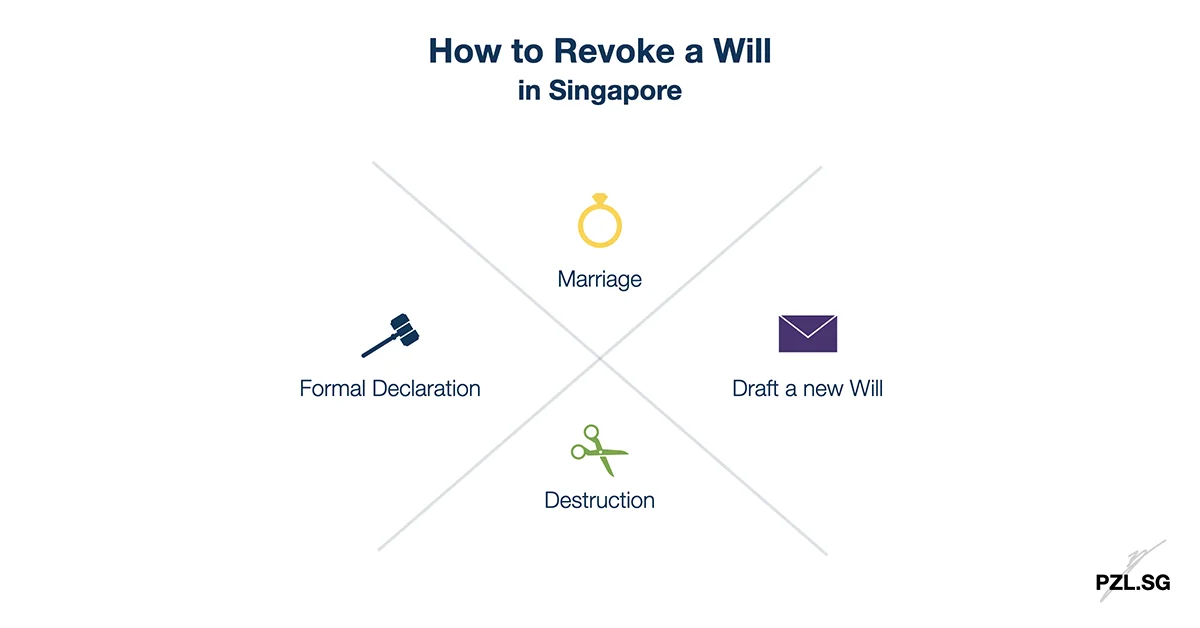
Altogether, there are four ways to revoke a Will in Singapore. Thereupon, we will revert your estate distribution to its previous arrangement. If there are no other formal arrangements, then we will apply the administrative process. In detail, we will administer and distribute your estate in accordance with the Intestate Succession Act (Cap. 146) (for non-Muslim estates) or in accordance with Muslim law (for Muslim estates).
Table of Contents:
One Minute Summary:
- To explain, a Will is a legal document to appoint an executor to carry out your instructions on how to manage your estate after your death.
- As a matter of fact, you can still make changes to your estate planning after you have written your Will.
- Altogether, there are four common ways to revoke a Will.
Part 1: What is a Will?
To begin with, let’s do a quick revision on a Will. According to the Wills Act (Chapter 352),
A will includes a testament and an appointment by will or by writing in the nature of a will in exercise of a power. In addition, it is also a disposition by will and testament and any other testamentary disposition.
In other words, it is a legal document to appoint an executor (someone who you trust). For the most part, the executor’s role is to carry out your instructions on how to manage your estate after your death.
Part 2: Purpose of a Will
As the testator, you can use a will to appoint an executor to manage both personal estate and real estate.
- Example of Personal Estate: Moneys, shares of a company, intellectual property, animals
- Example of Real Estate: Land
Additionally, you can also use a will to appoint guardians for minor children. Furthermore, you can include a letter of wishes to express your final words. By the same token, you may write a statement of encouragement and love for your loved ones.
Part 3: How to Revoke a Will?
In truth, it is not necessary to hire a lawyer to revoke a Will. Be that as it may, here are four common ways to revoke a Will.
Part 3.1: Formal Declaration
Firstly, you can make a formal declaration to revoke an existing Will. To point out, this process is similar to drafting a Will, i.e.
- You have to present the formal declaration in writing.
- Next, you must sign at the foot of the declaration in the presence of at least two witnesses.
- Finally, both witnesses must sign as witness in your presence.
Part 3.1.1: Must I draft a new Will?
In a word, no; you do not need to draft a new Will in order to revoke an existing Will. However, it must be remembered that if there are no other formal arrangements, then we will apply the administrative process for your estate.
Part 3.2: Revocation by a subsequent Will
After you revoke an existing Will, you may have the intention to draft a new Will. On this occasion, you do not need to separate the two steps. That is, revoke the previous Will, and then draft a new Will. Summing up, you can draft a new Will and insert a clause to state that this new Will is to override any existing Wills.
Part 3.2.1: Can you revert back to the old Will by destroying the new Will?
It is important to realise that you cannot enact the old Will by destroying the new Will. For the same reason as Part 3.1.1, we will apply the administrative process if there are no other formal arrangements for your estate.
Part 3.3: Destruction
Of course, you may burn, tear, or otherwise destroy the Will. In the same way, you may give direct permission to another person to destroy the Will on your behalf. For this purpose, you must be present to that end.
Part 3.4: Marriage
Finally, a Will is revoked automatically by marriage. This goes in the same way for your CPF nomination and insurance nomination. To clarify, marriage refers to the solemnisation and not the banquet itself (if they are two separate events held over a different period).
Part 3.4.1: Can You draft a Will in contemplation of a marriage?
Yes, you can include a clause to state that the Will is made in contemplation of a marriage. Consequently, the solemnisation of the marriage shall not revoke the Will.
Part 3.4.2: Does a divorce revoke the Will automatically?
No, a divorce has no effect on the status of your Will. If you want the estate distribution to reflect your latest marital status, then you should draft a new Will.
Part 4: Other Considerations
Generally, I will conduct an estate planning review with my clients when there is a major shift in their life’s priorities or life stage. For example, I will encourage my clients to draft a new Will when they get married. To point out, this becomes even more important when it is an interfaith marriage. This is because the “default” arrangement may not be your intended arrangement. On the other hand, you may also update your Will to welcome a new family member, or when a beneficiary leaves you.
While it seems like a chore to set up a Will and to review it regularly, it is still one of the simplest documents to keep your family together and to preserve your estate the way you intend it to be.
First Published: 26 February 2020
Last Updated: 25 May 2021


Leave a Reply